
If you’re thinking about taking down a tree in North Vancouver, the first question isn’t how big the tree is. It’s which North Vancouver you live in. The City of North Vancouver and the District of North Vancouver are separate municipalities with separate tree bylaws, and the rules are quite different.
This guide covers both, including what triggers a permit, what the process involves, and when you’ll need an arborist report. If you’re in Vancouver itself, see our complete guide to tree removal in Vancouver instead.
First, Which North Vancouver Are You In?
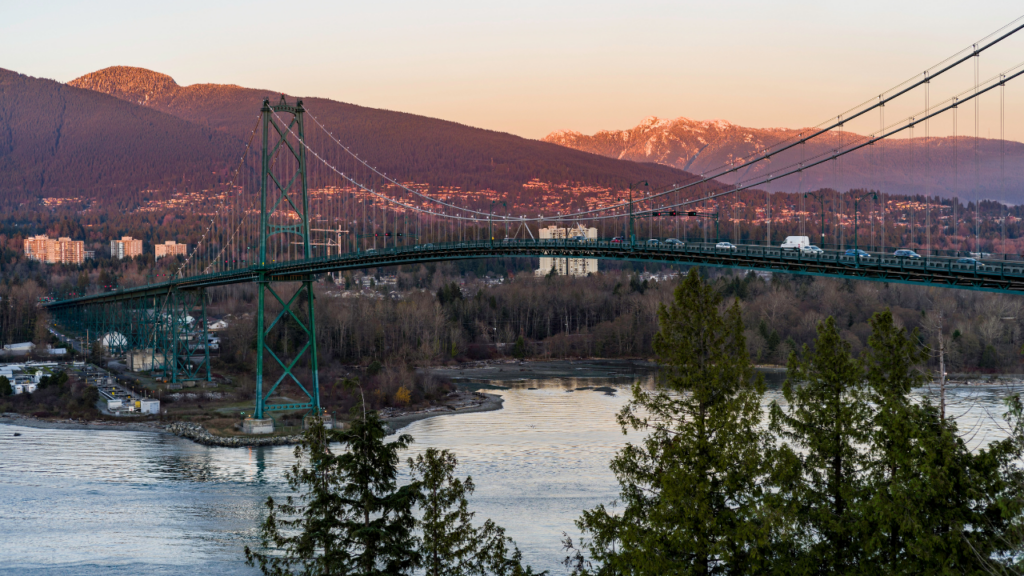
A North Vancouver mailing address doesn’t tell you which municipality you’re in. The City covers the central area around Lonsdale, from the waterfront up toward the Upper Levels Highway. The District wraps around it, taking in neighbourhoods like Lynn Valley, Edgemont, Deep Cove, Delbrook and Capilano Highlands.
The simplest way to check is your property tax notice, which comes from whichever municipality you belong to.
District of North Vancouver: When You Need a Permit
The District’s Tree Protection Bylaw 7671 covers two groups of trees.
Large diameter trees. Any tree 75 cm or more in diameter, measured 1.3 metres above the ground, needs a permit to remove. The same goes for pruning one.
Protected trees, whatever their size. These include:
- Any tree on, or straddling, District land such as a park, road or boulevard
- Trees within 15 metres of the top of a watercourse bank, or on slopes steeper than 36%
- Trees on wetland or within 30 metres of the waterfront
- Heritage trees, wildlife trees and trees 250 years old or older
- Replacement trees, and trees protected by a covenant on title
- Arbutus, Garry oak, Oregon ash, Pacific yew, western white pine and yellow cedar
Trees that are neither large diameter nor protected can be removed or pruned without a District permit. Because so much of the District is sloped and cut by creeks, it’s worth checking before assuming your tree is exempt.
What the District Process Looks Like
What you need to submit depends on the job:
| What you want to do | What the District asks for |
| Remove a large diameter tree | Tree permit application |
| Prune a large diameter or protected tree | Application and arborist report |
| Remove a hazardous protected tree | Application and arborist report |
| Remove any other protected tree | Contact the District for the document list |
If removing a large diameter tree would leave your lot with less than 20% canopy cover, you’ll need to replant: one new tree per tree removed on lots under 420 square metres, or three on larger lots. The District holds a security deposit until the new trees are planted and inspected.
Hazardous trees have their own route. If a qualified tree risk assessor confirms a tree is hazardous and the District agrees, it can issue a permit with no fee and no replanting requirement. If a tree is actively failing and needs emergency work, the failed parts must be left on site for inspection, and the attending arborist’s report is due within 48 hours.
Shared trees need consent from every owner. If more than a quarter of the trunk sits on District land, the tree counts as shared with the District.
City of North Vancouver: When You Need a Permit
The City’s Tree Bylaw No. 8888 protects any tree 20 cm or more in diameter at breast height, as well as replacement trees. That’s a much lower size threshold than the District’s.
There is a major exception, though. The bylaw doesn’t apply if the whole trunk sits on land zoned RS-1, RS-2, RS-4B, RT-1, RT-2 or GO (ground oriented), or on a comprehensive development zone based on those. Many single family and duplex properties fall into these zones, so plenty of City homeowners don’t need a City tree permit at all. Your zoning is the first thing to confirm.
Streamside rules still apply in the City. If your property is within a Streamside Protection and Enhancement Area, separate development permit guidelines cover tree removal.
What the City Process Looks Like
City applications are thorough. A complete application includes:
- An arborist report by a certified arborist, with photos, the size and health of each tree, and the effect on nearby trees and soil
- A tree protection plan for the trees staying on site
- A tree replacement plan covering species, size, location, soil volume and irrigation
- A site plan or survey
- Signed authorization from the property owner, and from every owner of a shared tree
- Proof that the company doing the work is qualified and insured
For replacement, the City requires three new trees for each protected tree removed, or one for each hazardous, dead or dying tree. An ecological compensation fee also applies to healthy protected trees. Where trees can’t be planted on site, cash in lieu may be accepted with staff approval.
The steps run in this order: submit the application, pay the application fee, wait for staff review, pay the remaining fees, and receive the permit. You then post notification signage before the work, and replacement trees are inspected over the following two years before your security is returned.
Quick Comparison
| District of North Vancouver | City of North Vancouver | |
| Size that triggers a permit | 75 cm diameter | 20 cm diameter |
| Protected regardless of size | Yes, a long list | Replacement trees |
| Single family lots exempt? | No | Yes, in the zones listed above |
| Arborist report | For pruning, hazard and protected tree removals | Always |
| Pruning permit needed? | For large diameter and protected trees | Not covered by the bylaw |
Bird Nesting Season Applies Everywhere
Whichever municipality you’re in, bird nests are protected by provincial and federal law. Both North Vancouver municipalities flag March 1 to August 31 as the main nesting season. Removals during those months may need a bird nesting survey from a qualified environmental professional. Our guide on when to prune trees in Vancouver explains how nesting season affects tree work.
When You Need an Arborist Report
In the City, every tree removal application needs one. In the District, you’ll need one to prune a large diameter or protected tree, to remove a hazardous protected tree, and usually to remove any other protected tree.
A good report does more than tick a box. It sets out the species, size and condition of the tree, why the work is needed, and what the arborist recommends, in the format the municipality expects. Incomplete applications slow everything down.
We write arborist reports for both North Vancouver municipalities, and our tree risk assessments cover the hazard tree route. If you’re not sure whether your tree needs a permit at all, an arborist consultation will answer that before you spend anything on paperwork. You can also read more about our tree services in North Vancouver.
For the District’s own guidance, see its tree protection and permits page.
Frequently Asked Questions
Do I need a permit to remove a tree in North Vancouver?
It depends on the municipality. In the District, you need one for trees 75 cm or more in diameter and for protected trees of any size. In the City, you need one for trees 20 cm or more, unless your property is in one of the exempt single family or duplex zones.
How do I know if I’m in the City or the District of North Vancouver?
Check your property tax notice, which comes from the municipality your property belongs to. A North Vancouver mailing address alone doesn’t tell you.
Can I remove a hazardous tree without a permit?
In the District, a hazardous tree still goes through a permit, but it can be issued with no fee once a qualified tree risk assessor confirms the hazard. In an emergency, work can go ahead, but the failed parts must stay on site and a report is due within 48 hours.
Do I have to plant replacement trees?
Usually. The City requires three new trees for each protected tree removed, or one for a hazardous, dead or dying tree. In the District, replanting applies when removing a large diameter tree would leave your lot with less than 20% canopy cover.
Do I need an arborist report?
Always, for a City application. In the District, you need one to prune a large diameter or protected tree and to remove a hazardous or protected tree.